
WHY VALKOIRA BUILT ATLAS
Our work kept finding the same problem: reality no longer fitted into isolated systems.
Projects, documents, models, organisations and software each held part of the picture. Valkoira built ATLAS as the factory behind our delivery so we can reconnect those fragments before deciding what should change or be built.
BUILT FROM REALITY, NOT FROM HYPE
ATLAS did not begin in a software lab.
Alexander Etzler's path runs from skilled trade and master craftsman work through company leadership, technical building services, construction and interface coordination to BIM, data, software and automation. ATLAS grew from repeatedly having to make complex real-world work understandable and workable.
Later work extended the same pattern into document and accounting automation, OCR, converters and interfaces. The recurring lesson was not that every problem needs new software. It was that reality, context and dependencies have to become understandable before the right change can be made.
That is the provenance behind ATLAS: physical reality → projects → organisations → documents → data → software → automation → qualified evolution.
These figures describe documented professional project experience; they are not ATLAS ROI, speed or customer-outcome claims.
ABOUT US
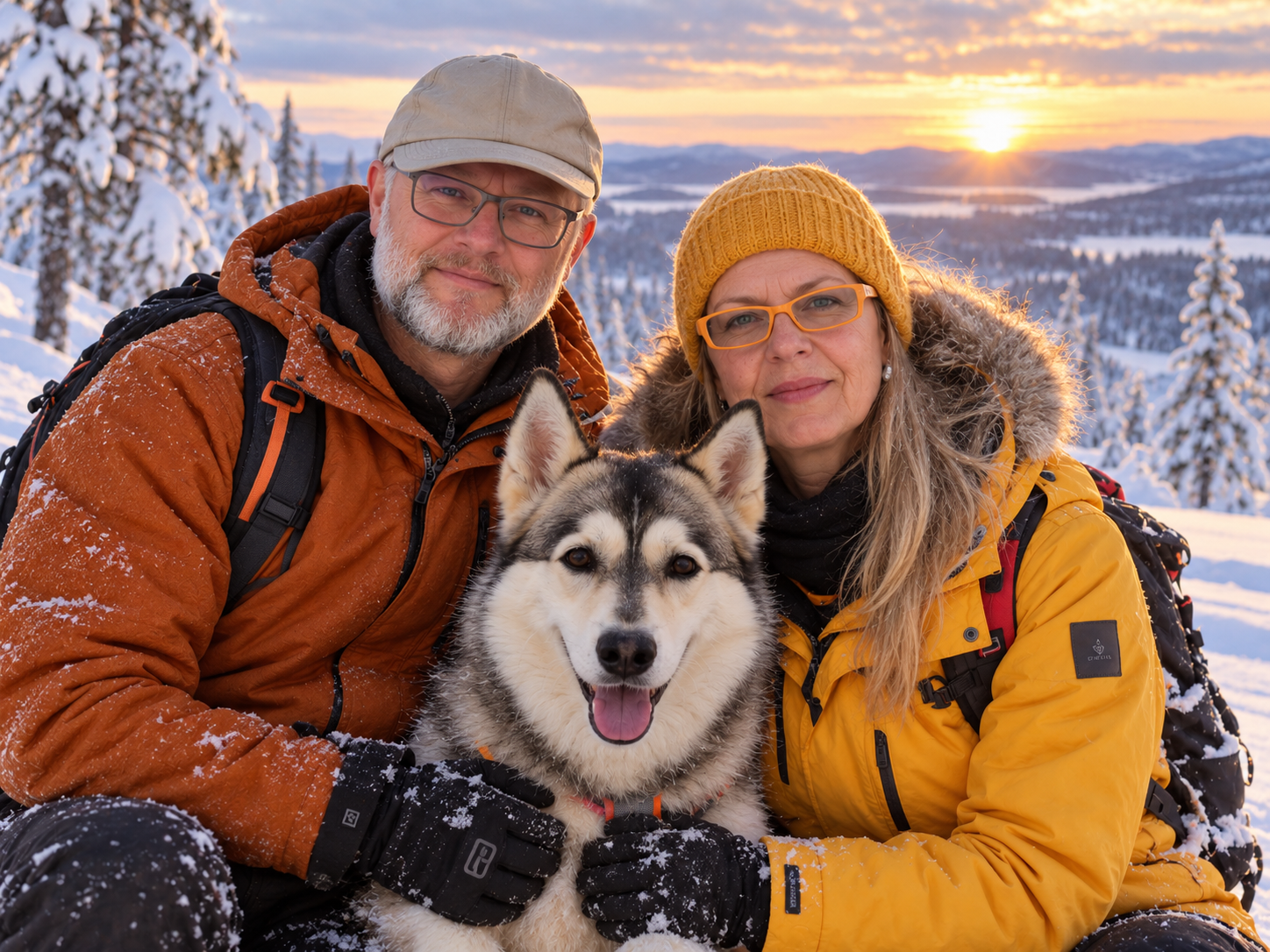
Two nonconformists, one dog, and the pursuit of systems that work.
The two of us live with our dog Aurora between the Taunus and Swedish Lapland – sometimes in the house, sometimes in the camper, and preferably close to nature. We hike, enjoy cooking with good ingredients, and can turn a small question into an evening-long discussion pretty quickly.
We like things that are well made and keep working for a long time. That is why we prefer repairing to replacing too quickly – from a favourite item to a machine. And when we cannot do something, we learn how until the solution really fits us.
Perhaps that also explains why the same question keeps coming up in our professional lives:
Why accept an unsuitable solution just because it is the one you were given?
Why Valkoira?
Valkoira stands for the white dog in a working harness pulling the sled through deep snow.
Not for show. For endurance, independence, and the ability to find a way even when none has been laid out.
The dog in front of the sled does not simply follow a line on a map. It works with the human, reads the terrain and conditions, and does its part so that both arrive.
We like that.
Good technology should not be the centre of attention either. It should do its part of the work and enable the human to do theirs.
Two worlds. The same realisation.
Our professional paths could hardly be more different. In two entirely different industries, the same fundamental problem appeared independently: work is often constrained not by missing technology, but by the way information, systems, and processes are connected.
ENGINEERING
When information loses its context.
In engineering, a single piece of information rarely decides anything. What matters is its relationship to other data, documents, models, equipment, requirements, and decisions.
The question of how information can not only be stored and processed, but connected in such a way that dependencies and effects become visible, arose long before today's technical possibilities.
The idea was there early. The technology was not.
In practice, the problem kept becoming visible, and especially clearly in complex major projects: the information existed, but it was distributed across disciplines, systems, documents, models, and people. Each system could work on its own and yet the context between them could still be lost.
The realisation: the problem is often not missing data. It is the lost context between it.
INSURANCE
When people close the gaps between systems.
Four decades in the insurance industry showed the same fundamental problem from a completely different perspective.
New applications were added, processes were digitised, and systems were connected. Yet information was still entered, transferred, checked, and supplemented multiple times. Excel sheets, manual intermediate steps, and workarounds became normal wherever applications and processes reached their limits.
People repeatedly recreated exactly the connections that were missing between systems. They transferred information, interpreted differences, checked results, and made sure the overall process still worked.
Not because that work was professionally necessary, but because the systems offered no other way.
The realisation: people should not be the interfaces between systems. Their experience is needed where judgement and responsibility begin.
ATLAS · FROM REALITY TO QUALIFIED EVOLUTION
Complexity does not need another explanation. It needs a way to become understandable.
ATLAS begins with what is actually there: people, systems, documents, dependencies, evidence and unknowns. It makes their relations visible before deciding what should change.
What is actually there
People, systems, documents and work already exist before a solution is chosen.
What depends on what
Connections, interfaces and dependencies become visible instead of remaining tribal knowledge.
What do we really know
Observed, evidenced and unknown are kept distinct. Uncertainty is not silently filled in.
What does it mean
The situation becomes a model people can inspect and question without needing to read the machinery underneath.
What should change
Existing capabilities are reused and composed first. Only a real gap justifies something new.
Did reality actually change
The effect is observed again. A plan, model or generated answer is not treated as proof of the real outcome.
For a decision-maker, this can be simple: first understand the situation, then choose the smallest justified change.
I want to understand the technical depth
Underneath the human view, ATLAS keeps subjects, relations, evidence, uncertainty, authority, specifications, capabilities and observed effects machine-readable. Human views are projections of that reality, not a second source of truth.
This illustration explains the working philosophy. It does not claim that every situation is automatically understood, solvable or authorized for change.
ATLAS did not begin with software. It began with a why.
The way of thinking behind ATLAS is older than ATLAS itself.
Already in youth, the idea emerged of processing information differently: not as separate pieces of data, but as parts of a context. What mattered was not only what a computer knew, but how information was connected and what could be derived from those connections.
Even early on, the same question kept coming up:
Why does so much repeat itself – and why do we still reinvent it every time?
In the trades, it became very practical: behind different tasks, similar structures kept appearing. Much could be prepared, reused, and assembled to fit.
The terms for this came much later. The drive behind it was already the same:
Why – and how can it be automated?
Because this principle appears everywhere – in the real world as well as the digital one.
The idea was there. The technology to implement it with this consistency was not, for a long time.
In 2019, the question did not change. The possibilities did.
At FAIR/GSI, 3D coordination brought science, construction, and machines together in an information landscape where foundations, data, and documents were distributed across systems and people. The available tools each represented parts of the picture, but not the context that was decisive for the actual task.
Programming was familiar from youth. Out of necessity, it became a tool again.
And the old question took on a new form:
Not: how do we program this?
But: how would a machine approach this problem?
That was a change of perspective, not a transfer of authority to a machine.
From this came initial automations and, over almost two years, a largely automated 3D model that brought science, construction, and machines together.
Later came around 480,000 documents without sufficient relationship and lineage. Python, MariaDB, and OCR made more and more connections technically tangible.
With every technical answer, the underlying question became larger:
How does information, with its context, dependencies, and meaning, reach exactly the place where it has consequences?
From this way of thinking, practical experience, and the technical possibilities that had meanwhile become available, ATLAS developed over years:
Technology and a working framework for human responsibility, specialised AI systems, and deterministic checks – without turning uncertainty into certainty.
Your IT works for you – not the other way around.
This is not a product claim, but the attitude behind our work: understand the real state, question ballast, and think working systems through to the end.
Technology does not need to impress. It needs to work.
Enough system chaos?
Describe what does not work today and what should work in the end.
WHY ATLAS EXISTS
ATLAS has come to shape the digital world together with you — while human purpose remains human.
ATLAS is not the purpose. It supports people in making complex digital reality understandable, changeable and evolvable while evidence, uncertainty, responsibility and authority remain explicit.
PUBLIC DIGITAL · LIVE PROJECTION
One reality can be projected differently without becoming different truths.
This public experience is the first visible blueprint: a visitor, a decision-maker and a machine can need different views while evidence, UNKNOWN, scope and authority remain bound underneath. The website is therefore not presented as proof of every future interface — it is a working public projection of the principle.
See the ATLAS working model → · Inspect evidence boundaries →