Accounting without receipt ping-pong
Receipts, email, supplier, payment and booking stay connected. People see exceptions; known flows can continue automatically.
 VALKOIRAIT SERVICES · SOFTWARE · AUTOMATION
CONNECTED BUSINESS · MODULAR SOFTWARE · CONTROLLED CHANGE
Customers, projects, communication, documents, accounting and planning belong together. Yet businesses are often left connecting separate systems by hand. ATLAS starts from one qualified machine foundation, with different views and capabilities for different needs. Start with what you need today. Add what matters tomorrow — without starting over each time.
ATLAS FACTORY composes qualified patterns, grammar and specifications into systems shaped around real needs. What is already understood can be reused; what is new must be qualified.
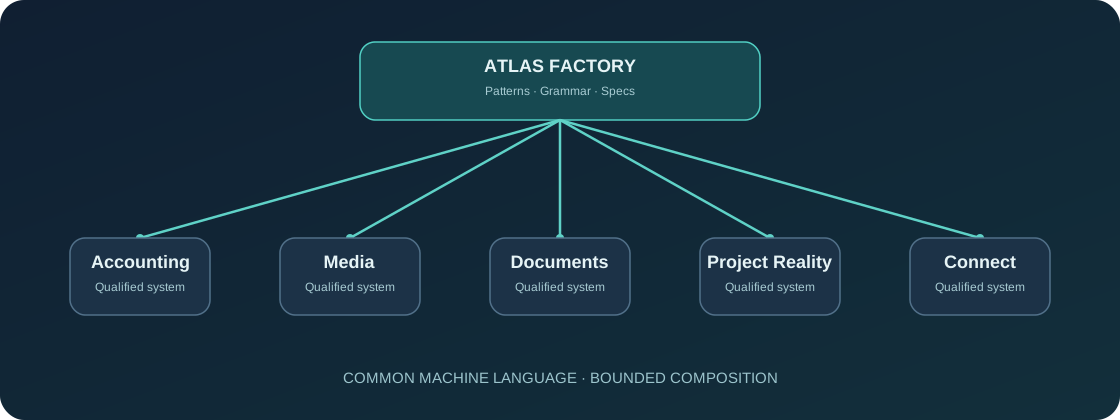
ONE QUALIFIED FOUNDATION · MANY PURPOSE-BUILT VIEWS
A customer relationship connects messages, contracts, invoices, payments and business planning. Those links should not depend on people copying information between software islands.
ATLAS connects what belongs together: enterprise workflows, data, mail, accounting and planning can serve different purposes on a shared, qualified information foundation. Existing systems can remain connected where that is useful.
Need a live business plan later? A qualified module can add that capability to the existing foundation when its prerequisites are met. Not another isolated platform, and not an automatic promise of instant deployment. Changes are scoped and verified.
WHAT THIS CAN BECOME
Tell us what should work in your organisation. The result can be the software, automation or connection of existing systems that your work actually needs.
Receipts, email, supplier, payment and booking stay connected. People see exceptions; known flows can continue automatically.
Documents, decisions, tasks, CAD/3D and changes can appear as one project context — with the right view for office, site or machine.
ERP, CRM, specialist software or older systems do not have to disappear. We can connect them and bring information together where breaks exist today.
If your reality connects accounting, documents, AI, production, mail and your own domain logic, the solution does not have to be split into artificial products.
Individual is not an exception here. What matters is what your work actually needs.
WHY ATLAS CAN DO THIS
ATLAS is the machine-native foundation behind this approach: existing knowledge is reused, changes stay controlled and results remain verifiable. For businesses facing growing software complexity and automated cyber threats, these architectural principles also create a promising foundation for stronger operational awareness, more controlled access and resilient automation. Security potential follows from the architecture — not from another layer added afterwards.
What already exists, what belongs together and what is genuinely still open?
Before another special solution is created, we check whether existing structure can already carry the new task.
Changes are bounded and introduced into the existing state instead of rebuilding the surrounding system without need.
Execution alone does not define success. What matters is what actually works afterwards.
PROOF BEFORE PROMISE
We prefer reproducible evidence to polished demos. A change is not successful because it was executed; it has to be checked against what should be true afterwards. Where that proof does not exist yet, the state stays open.
We separate what was actually observed from what is still interpretation, expectation or open work.
Changes are introduced against an explicit current state instead of silently overwriting what already exists.
The result is checked again after the change. Execution alone is not the proof.
THE NEXT STEP
A new interface, a better process or an idea held back by existing software: start with the business goal. We examine what already works, which qualified capabilities can be reused and what would actually need to change. That brings earlier clarity about feasibility and scope — without reinventing the technical foundations each time.
No formal specification required. No product to choose. A concrete situation is enough.
FREQUENTLY ASKED QUESTIONS
Custom software, process automation, system integration, legacy modernization and document or knowledge workflows — especially where manual work, disconnected systems or missing context slow the business down.
No. We first understand what already works. Useful systems and business logic can remain while missing connections or capabilities are added where they create value.
No. Describe what slows work down today and what should work better instead. We can clarify the technical path together.
Yes. The systems are designed so bounded changes can be introduced and checked without automatically rebuilding everything around them.
We make the desired result explicit, preserve useful existing behavior, change only what is needed and check the result after the change.
Tell us what does not work well today, what should work better and why it matters. A specification or product selection is not required for the first conversation.